
The global absorbent hygiene products (AHP) industry operates under tight margin constraints, rapid technological obsolescence, and fluctuating raw material pricing. For manufacturers of baby diapers, adult incontinence items, and feminine care products, managing capital assets and inventory liabilities remains a constant operational challenge. While consumer-facing trade-in programs are common in other consumer electronics sectors, the concept of a structured industrial diaper trade in program is gaining rapid traction in the business-to-business (B2B) hygiene manufacturing supply chain. This approach provides a systematic methodology for producers to upgrade their production machinery, recover value from obsolete raw materials, and streamline operational efficiency.
Managing capital expenditures (CapEx) for high-speed diaper converting lines requires strategic foresight. A modern production line representing multi-million-dollar investments can become outdated within years due to changes in product design, such as the shift from traditional thick cores to ultra-thin channels and fluffless cores. Consequently, organizations like KIMEPR are supporting industrial initiatives that facilitate asset modernization, helping manufacturers transition from older mechanical platforms to high-performance, full-servo systems without bearing the full burden of initial capital investments.
The Structural Challenges in Modern Hygiene Manufacturing
To understand the utility of an industrial exchange program, one must examine the specific systemic pain points currently facing global hygiene manufacturers.
1. Rapid Machinery Obsolescence and Mechanical Wear
Standard diaper manufacturing lines operate at speeds ranging from 500 to 1,200 pieces per minute. The mechanical stress on rotary die cutters, drum forming units, and ultrasonic bonding systems is immense. Over a five-to-seven-year cycle, these components suffer from wear that degrades product consistency, leading to increased rejection rates. Furthermore, older pneumatic or semi-servo machines lack the precision of modern full-servo drive technologies, which allow for independent tension control of elastic bands, nonwovens, and acquisition distribution layers (ADL).
2. Raw Material Excess and Shelf-Life Limitations
The manufacturing of a single baby diaper requires the precise synchronization of multiple raw materials, including:
Spunbond-meltblown-spunbond (SMS) nonwovens for barrier leg cuffs
Superabsorbent Polymers (SAP) with specific absorption under load (AUL) characteristics
Fluff pulp and specialized elastomeric films
Hot-melt adhesives with temperature-sensitive degradation curves
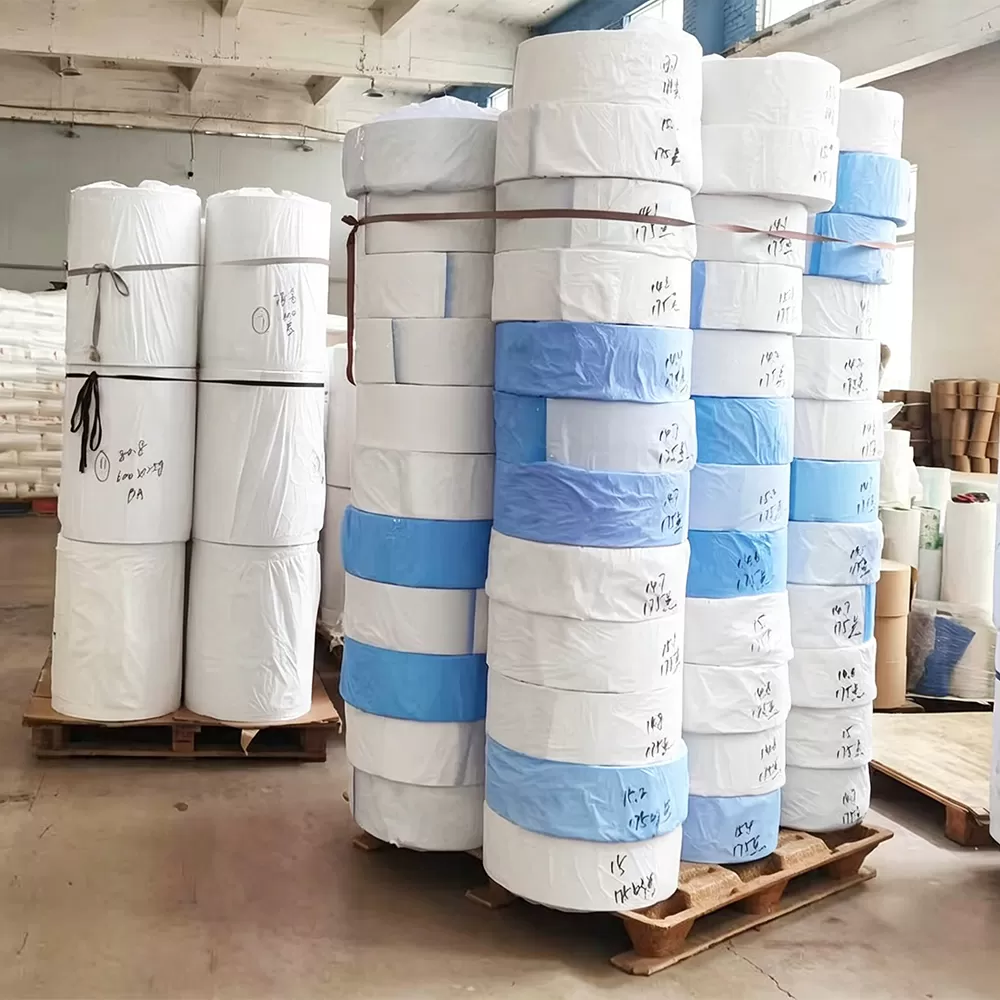
Changes in product specifications often leave manufacturers with hundreds of metric tons of unusable, obsolete roll goods. These materials occupy expensive warehouse space and degrade over time due to humidity and temperature fluctuations, eventually leading to direct write-offs.
The B2B Diaper Trade In Mechanism Explained
A B2B diaper trade in framework functions as an asset recovery and modernization program. Rather than discarding depreciated machinery or selling surplus raw materials at a total loss on secondary broker markets, manufacturers can leverage structured trade-in agreements to offset the cost of new equipment or updated raw material formulations.
This process typically involves three distinct pathways:
Equipment-for-Equipment Upgrades
Under this pathway, a manufacturer trades in a legacy semi-servo or mechanical diaper line. The trade-in provider assesses the residual value of the machine frame, main drive shafts, unwinder stations, and ancillary equipment. This evaluated value is applied as a direct credit toward a new, high-efficiency full-servo production line. The older machine is subsequently refurbished, retooled, and deployed to markets with lower speed requirements or used as a dedicated line for lower-tier product segments.
Material-for-Machinery Credits
In cases where raw material inventory is unbalanced—such as possessing an excess of hydrophobic nonwovens but a deficit in high-grade SAP—the manufacturer can utilize a material trade-in program. Excess roll goods of certified quality are valued based on current commodity indexes and exchanged for credits that can be applied to machine spare parts, upgrade kits, or auxiliary equipment, which helps maintain operational continuity.
Refurbishment and Retooling Synergies
Many factories do not require completely new machinery but need to adapt to changing consumer preferences, such as transitioning from open diapers to pant-style diapers. A structured trade-in allows specific modules (such as the waist-band application unit or the final folding system) to be swapped out. This modular approach minimizes downtime and prevents the capital waste of decommissioning an entire line.
Evaluating the Economic and Engineering Viability
Before entering into a diaper trade in agreement, manufacturing directors and procurement teams must perform a comprehensive evaluation of their existing assets. This analysis is divided into mechanical audits and material quality assessments.
| Asset Category | Evaluation Parameters | Trade-In Value Drivers |
|---|---|---|
| Converting Machinery | Servo motor operating hours, PLC model compatibility, frame structural integrity, wear on rotary cutters. | High if the machine frame is robust and compatible with modern PLC upgrade kits (e.g., Beckhoff or Siemens systems). |
| Nonwoven Roll Goods | Tensile strength in machine direction (MD), basis weight uniformity, moisture content, storage duration. | High if rolls are stored in climate-controlled environments and retain original manufacturer certifications. |
| Superabsorbent Polymer (SAP) | Centrifuge Retention Capacity (CRC), Absorption Under Load (AUL), particle size distribution. | Variable; dependent on moisture barrier integrity of the packaging and current global acrylic acid market prices. |
By conducting these structured assessments, companies can accurately forecast the return on investment (ROI) of their upgrade cycles. This rigorous methodology ensures that asset valuations are realistic, predictable, and aligned with international accounting standards for equipment depreciation.
Environmental Sustainability and Circular Economy Integration
The hygiene manufacturing sector is under increasing pressure from regulatory bodies and consumer groups to reduce its environmental footprint. Landfilling industrial waste—such as off-spec diapers, material trim, and outdated raw materials—is becoming increasingly expensive and socially unacceptable. A structured diaper trade in program directly supports circular economy initiatives by extending the lifecycle of industrial machinery and minimizing raw material waste.
When a machine is traded in and refurbished, the carbon footprint associated with smelting new steel, manufacturing new servo drives, and transporting heavy industrial components is reduced. Similarly, redirecting excess nonwoven rolls to other industrial applications (such as filtration media, geotextiles, or automotive insulation) prevents valuable synthetic polymers from entering waste streams. This alignment with environmental goals helps manufacturers meet their environmental, social, and governance (ESG) targets while simultaneously improving their balance sheets.
Strategic Procurement and Production Line Integration with KIMEPR
Implementing an asset-exchange strategy requires a reliable, experienced partner who understands the nuances of hygiene engineering. KIMEPR provides the necessary expertise to facilitate these complex transactions, offering accurate equipment valuations, logistics support, and smooth integration of replacement machinery.
Through systematic collaboration, KIMEPR helps production facilities assess their current floor layout, identify bottlenecks in old converting systems, and design a phased trade-in schedule that prevents prolonged production stoppages. This ensures that the transition from legacy systems to advanced manufacturing platforms is executed with minimal disruption to ongoing supply chains.

Structuring Your Next Operational Move
Addressing the challenges of capital utilization and inventory obsolescence requires innovative approaches. A structured diaper trade in program offers a practical, economically sound path for hygiene manufacturers looking to modernize their production lines, recover capital from idle assets, and reduce industrial waste. By systematically assessing older machinery and surplus raw materials, manufacturers can improve their operational efficiency and maintain a competitive edge in a demanding market.
To learn more about how a customized trade-in program can benefit your manufacturing facility, or to request a professional valuation of your current machinery and excess raw materials, please contact our engineering and logistics specialists. Submit your formal inquiry today to receive a detailed feasibility analysis tailored to your production requirements.
Frequently Asked Questions
Q1: What types of machinery are typically eligible for a B2B diaper trade in program?
A1: High-speed baby diaper converting lines, adult incontinence diaper machines, underpad production lines, and sanitary napkin machines are eligible. Both full-servo and semi-servo configurations can be evaluated for trade-in value, depending on the condition of the main frame and mechanical components.
Q2: How is the value of obsolete or surplus raw materials determined?
A2: Raw material valuation is based on material specifications (such as GSM, roll width, and tensile strength), age, storage conditions, and current market demand for polymers and pulp. All materials undergo laboratory testing to verify that their physical properties comply with industrial application standards.
Q3: Will participating in a trade-in program cause significant production downtime?
A3: Downtime is minimized through phased logistics planning. Replacement modules or new machinery are prepared and tested prior to the decommissioning of the old equipment. Installation schedules are aligned with planned maintenance windows to preserve production targets.
Q4: Can we trade in partial machinery modules rather than an entire production line?
A4: Yes, modular trade-ins are highly common. Manufacturers can trade in specific components, such as outdated SAP dosing systems, elastic waistband applicators, or packaging units, for newer, more efficient modules compatible with their existing frames.
Q5: What happens to the older machinery after it is traded in?
A5: Traded-in machinery undergoes a thorough remanufacturing process. This includes replacing worn mechanical parts, updating control systems to modern PLC standards, and reconfiguring the machines for secondary markets or specialized, lower-speed production runs.