

Demand for baby diaper pants, commonly known as pull-ups, continues to climb worldwide. Active toddlers need freedom of movement, and parents demand quick changes without compromising leak protection. Behind every high-performing training pant lies a complex bill of materials engineered for comfort, stretch, and fluid retention.
Building a successful hygiene brand requires a deep understanding of pull-ups raw materials. Product developers and procurement managers cannot simply rely on generic specifications. Every layer must interact seamlessly with the next to ensure high absorption speeds, low rewet, and comfortable fit.
At KIMEPR, we work directly with global hygiene brands to source, test, and optimize raw material combinations. Whether you run high-speed converter lines or develop private-label diaper pants, choosing the right material mix dictates your production yield and customer satisfaction.
Are you looking to optimize your procurement costs or improve line speeds? Contact our technical team today to request material spec sheets and trial samples.
Pull-ups vs. Traditional Open Diapers: What Makes the Materials Different?
Open tape diapers and pull-up pants share basic absorption principles, but their structural requirements diverge significantly. Traditional diapers rely on frontal tapes, side wings, and landing zones to secure the product around a baby's hips. Pull-up pants eliminate these components entirely.
Instead, pull-ups use an engineered 360-degree elastic waistband that allows the pant to slide on like underwear. This structural shift introduces unique material challenges. The non-wovens used for the outer waistband must withstand high tension while remaining soft against sensitive skin.
Furthermore, pull-ups undergo ultrasonic side-seaming during manufacturing. The outer and inner materials must be thermally or ultrasonically compatible to form clean, tearable side seams that do not burst during wear yet tear open easily during removal.
The Core Anatomy: 7 Essential Pull-ups Raw Materials Explained
To produce an exceptional training pant, converter plants assemble a complex stack of web materials, polymers, and adhesives. Here is the detailed engineering breakdown of the seven core pull-ups raw materials.
1. Non-Woven Fabrics (Topsheet and Barrier Leg Cuffs)
Non-woven fabric for baby diapers makes up the majority of the product's skin-contact surface. Two distinct non-woven categories serve critical functions inside the pant:
- Hydrophilic Topsheet: The topsheet sits directly against the baby's skin. Manufacturers favor Hot-Air Through (HAT) non-woven (typically 18 to 22 gsm) over standard spunbond because it offers superior cloud-like softness, rapid fluid strike-through, and minimal moisture retention.
- Hydrophobic Leg Cuffs: The standing inner leg barriers require Spunbond-Meltblown-Spunbond (SMS or SMMS) non-wovens (12 to 15 gsm). Treated with hydrophobic agents, these fabrics block side leaks while remaining breathable.
Choosing the correct non-woven grade prevents friction rashes, lowers rewet values, and maintains product integrity when wet.
2. Super Absorbent Polymer (SAP)
Super Absorbent Polymer (SAP) for diapers serves as the primary fluid retention engine. These cross-linked sodium polyacrylate granules can absorb up to 50 times their weight in saline solution under pressure.
Procurement teams evaluate SAP across three vital metrics:
- Centrifuge Retention Capacity (CRC): Measures how much liquid the polymer retains after spinning (usually 30 to 35 g/g).
- Absorption Under Load (AUL): Measures fluid uptake while subjected to pressure, such as a sitting toddler (typically 20 to 25 g/g at 0.7 psi). High AUL prevents gel leakage under body weight.
- Absorption Speed (Vortex): Indicates how fast the polymer pulls liquid in. Faster speeds prevent surface pooling during heavy gushes.
3. Fluff Pulp (Wood Pulp)
Defibrated wood pulp fibers act as the internal transport network inside the absorbent core. Fluff pulp draws fluid away from the initial insult zone through capillary action and distributes it to the surrounding SAP particles.
Most premium diaper pants use Elemental Chlorine-Free (ECF) or Totally Chlorine-Free (TCF) bleached kraft pulp. While modern diaper designs increasingly adopt ultra-thin composite cores with lower pulp ratios, wood pulp remains essential for structural core integrity, cushion, and quick initial intake.
4. Elastic Waistband Materials (Spandex and Elastic Film)
The elastic waistband defines the performance of pull-ups. If the tension is too high, the diaper leaves red marks on the toddler's waist. If it is too low, the pant sags when filled with liquid.
Converter lines run multiple strands of synthetic polyurethane thread (elastane or spandex, typically 560 to 840 dtex) sandwiched between two non-woven layers. Alternatively, high-end pants use breathable elastic laminate films. KIMEPR works closely with converter partners to dial in precise elongation curves, ensuring the waistband expands easily during application and retracts gently during active movement.
5. Breathable Backsheet Film
The bottom layer of the diaper pant must keep clothing dry while letting hot, humid air escape. This breathable backsheet film consists of a microporous polyethylene (PE) film laminated to a soft spunbond non-woven outer layer.
The PE film contains calcium carbonate fillers that create microscopic pores during biaxial stretching. These pores are large enough for water vapor molecules to pass through, but small enough to block liquid water droplets. Quality controllers track the Water Vapor Transmission Rate (WVTR), aiming for 2,500 to 4,000 g/m²/24h to combat diaper rash effectively.
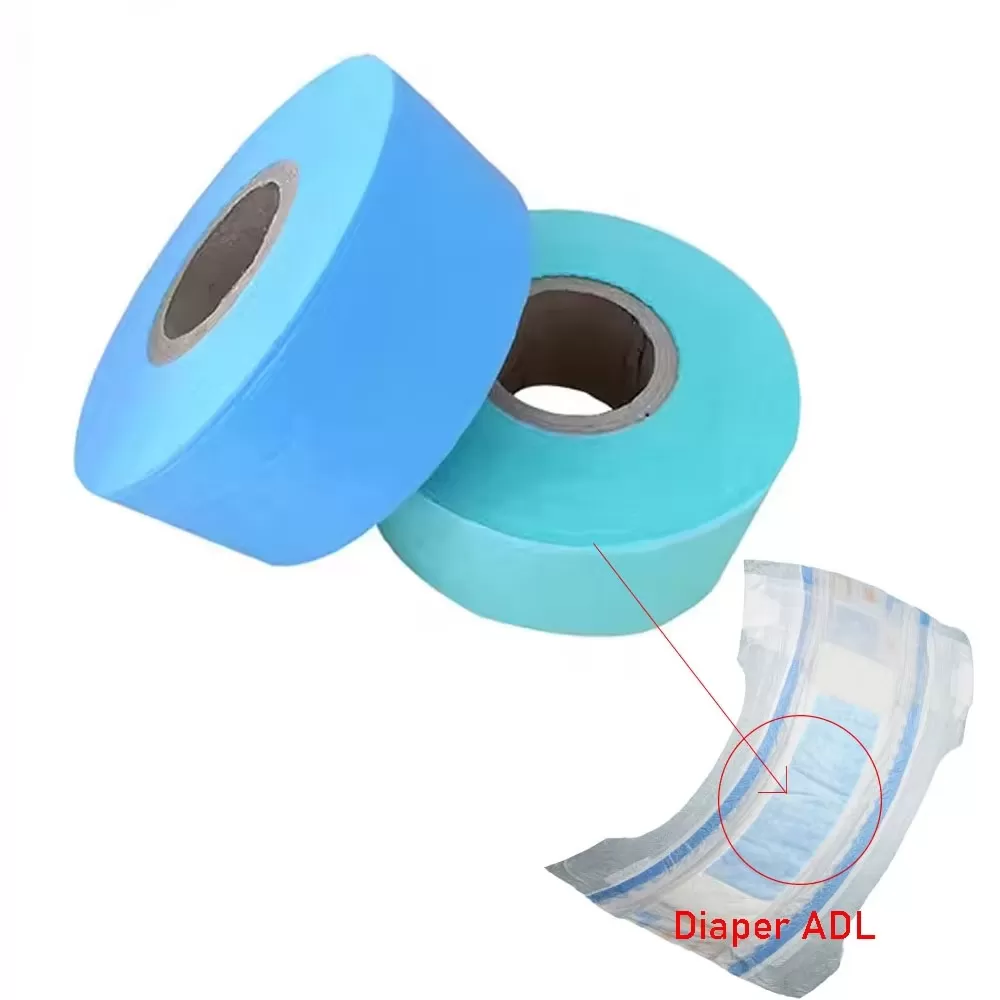
6. Acquisition Distribution Layer (ADL)
Urine arrives in sudden, high-volume bursts. Because SAP absorbs fluid relatively slowly, an intermediate layer must temporarily hold and spread the liquid before the core saturates.
The Acquisition Distribution Layer (ADL) sits directly below the topsheet. Usually made from high-loft, through-air bonded polyester or bicomponent fibers (30 to 50 gsm), the ADL distributes liquid along the length of the diaper pant. This lateral spreading prevents local saturation spots and minimizes surface rewet.
7. Hot Melt Adhesives (HMA)
Industrial adhesives hold all layers together at high processing speeds (often exceeding 600 to 800 pants per minute). Diaper pants require two main adhesive types:
- Construction Adhesive: Bonds non-woven layers to the backsheet, ADL, and core tissue. Formulated from synthetic polymers (such as SBS or APAO), it must remain flexible and odor-free.
- Elastic Attachment Adhesive: Locks spandex threads into place under constant tension. It requires high creep resistance to ensure elastic strands do not snap back inside the waistband over time.
Adhesives must meet stringent low-VOC (volatile organic compound) standards to prevent chemical odors inside the finished packaging.
The Impact of Raw Material Quality on Finished Pull-ups Performance
Using sub-par raw materials causes direct failures on the manufacturing floor and in consumer homes. Here is how material quality links directly to product metrics:
- Line Efficiency: Inconsistent non-woven tensile strength causes web breaks on converting machines, leading to expensive downtime and material waste.
- Leak Resistance: Weak hydrophobic leg cuffs or low-AUL SAP allow side leaks when babies sleep on their sides or sit down.
- Skin Health: Backsheets with low breathability trap heat and humidity inside the pant, accelerating ammonia breakdown and creating painful diaper dermatitis.
Future Trends in Pull-ups Raw Materials
The hygiene sector continues to adapt to consumer preferences and environmental regulations. Material development now emphasizes sustainability and extreme thinness.
First, bio-based non-wovens are gaining significant ground. Brands increasingly replace petrochemical polypropylene with polylactic acid (PLA), bamboo fibers, or certified organic cotton for topsheets. Producers are also testing bio-based SAP derived from starch or cellulose frameworks to lower carbon footprints.
Second, core construction is moving toward ultra-thin composite cores. By using specialized thermal-bonded or airlaid webs to lock high concentrations of SAP in place without fluff pulp, manufacturers can reduce total diaper thickness by up to 50%. This shift lowers packaging volume, slashes ocean freight costs, and delivers a sleeker profile under toddler clothes.
Sourcing Guide: How to Select Reliable Pull-ups Raw Material Suppliers
Choosing the right hygiene product raw material suppliers requires looking past simple price-per-ton metrics. To ensure seamless plant operations, review suppliers based on the following criteria:
- Technical Certifications: Verify that non-wovens, films, and polymers comply with international safety standards, including ISO 9001, OEKO-TEX Standard 100, REACH, and FDA registrations.
- Batch-to-Batch Consistency: Request historical Certificate of Analysis (COA) data. A 2% variance in basis weight or tensile strength can trigger frequent jams on automated lines.
- Supply Chain Redundancy: Confirm that your supplier maintains multiple production facilities and dependable access to virgin resin and chemical feedstocks.
- Technical Support: Reliable vendors provide application engineers who understand converter dynamics and can troubleshoot bonding, tensioning, and cutting issues on-site.
At KIMEPR, our quality control protocols ensure that every shipment of raw materials meets tight mechanical and chemical tolerances before leaving the factory.
Frequently Asked Questions
Q1: What is the most critical raw material determining the absorbency of pull-ups?
A1: Super Absorbent Polymer (SAP) is the primary determinant of fluid retention. While the Acquisition Distribution Layer (ADL) handles fluid uptake speed and fluff pulp distributes liquid, SAP physically locks moisture away under pressure to prevent rewetting the baby's skin.
Q2: Why do pull-ups use Hot-Air Through non-woven instead of standard Spunbond?
A2: Hot-Air Through (HAT) non-woven uses bicomponent fibers bonded by hot air rather than heated embossing rollers. This process yields a loftier, plush texture with lower density. HAT feels significantly softer against delicate skin and facilitates faster fluid penetration than flat calendered spunbond fabrics.
Q3: How do manufacturers prevent odor in diaper pant adhesives?
A3: Suppliers use hydrogenated hydrocarbon resins and pure base polymers with low volatile organic compound (VOC) levels. High-grade hot melt adhesives undergo vacuum stripping during manufacturing to eliminate residual monomers and process odors that could trigger consumer complaints.
Q4: Can standard baby diaper machines produce pull-ups with the same raw materials?
A4: No. Pull-up manufacturing lines require specialized web feeding, tension control, and ultrasonic bonding stations for the elastic waistband. The materials must also possess specific tensile and thermal characteristics to support 360-degree waist assembly and ultrasonic side-seam cutting.
Q5: What is the standard shelf life of pull-ups raw materials in storage?
A5: Most synthetic non-wovens and backsheet films remain stable for 12 to 24 months when stored in clean, climate-controlled warehouses away from direct UV exposure. However, SAP and fluff pulp are hygroscopic and must be protected from ambient humidity to prevent premature clumping and moisture absorption.
Build a Superior Diaper Pant with Premium Materials
A diaper pant is a precision-engineered consumer hygiene product. From the initial strike-through of the non-woven topsheet to the elastic waistband's recovery and the backsheet's breathability, each component impacts brand reputation.
Balancing material performance, runnability, and cost structure requires an experienced supply partner. Partnering with KIMEPR gives your brand access to certified raw materials, steady supply chains, and technical consulting tailored to your converter machinery.
Ready to elevate your pull-up production? Send your target technical specifications to our sourcing specialists today to request our comprehensive diaper pant raw material list and volume pricing.