
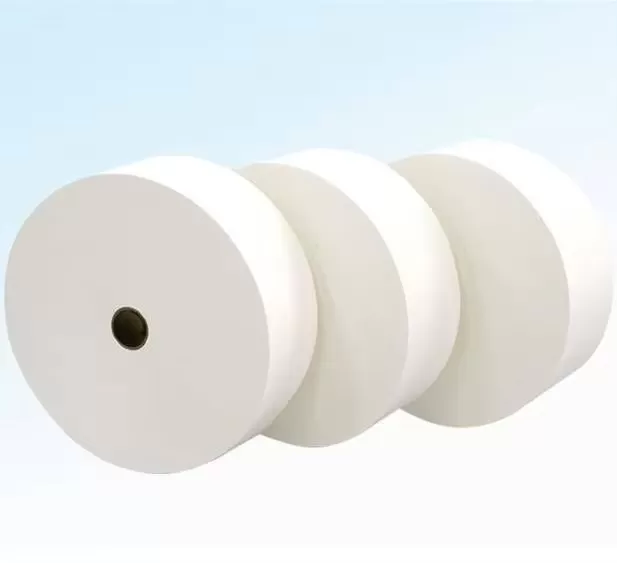
Absorbent hygiene product manufacturing requires an exacting balance between absolute barrier integrity and physiological comfort. Traditional polyethylene barriers, while impervious to fluids, act as thermal and vapor insulators that accelerate humidity accumulation within disposable diapers and feminine care pads. This thermal-vapor microclimate significantly degrades skin health, elevating transepidermal water loss and predisposing skin to erythema. Overcoming this design constraint drove the development of the breathable PE backsheet film, a microporous membrane technology that permits the diffusion of air and perspiration while functioning as a total barrier to liquids.
Modern hygiene production lines operating at line speeds up to 1,000 meters per minute demand ultra-consistent mechanical specifications. The interaction between raw resin formulation, compounding parameters, machine direction stretching, and subsequent converting properties dictates both the productivity of the production line and end-user skin dermatological metrics.
Polymer Physics and the Microporous Formation Mechanism
Breathability in continuous polyolefin films does not rely on mechanical macro-perforations, which introduce fluid transmission paths. Instead, breathability is achieved through sub-micron interfacial void formation, commonly referred to as cavitation. This phenomenon hinges on the precise combination of non-polar polymers and mineral fillers followed by thermal-mechanical orientation.
Raw Material Formulation Dynamics
The standard composition for breathable backsheets involves a precise blend of linear low-density polyethylene (LLDPE) combined with high concentrations of finely milled, surface-treated calcium carbonate (CaCO3). LLDPE provides the elongation, tear resistance, and tensile modulus needed for web handling, while fractional melt index low-density polyethylene (LDPE) or high-density polyethylene (HDPE) components are added to tailor melt strength and processability during the extrusion phase.
Polymer Matrix Selection: Metallocene-catalyzed LLDPE (mLLDPE) is typically chosen for its narrow molecular weight distribution, yielding uniform mechanical stress distribution under orientation.
Mineral Filler Specification: Calcium carbonate typically accounts for 45% to 60% of the compound by total weight. The particle size distribution is critical; an average diameter (d50) between 0.8 and 1.5 microns is standard. Particles must be coated with stearic acid to reduce interfacial energy, prevent agglomeration, and ensure uniform dispersion inside the polyolefin melt.
The Cavitation Process via Machine Direction Orientation (MDO)
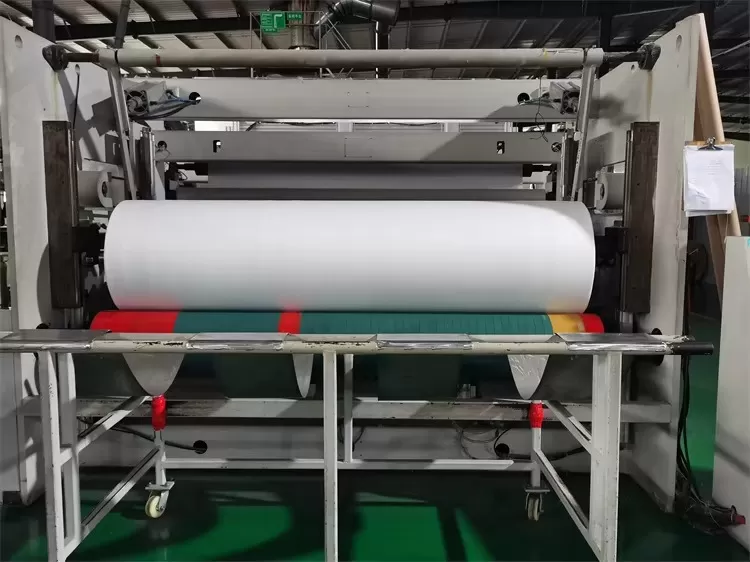
The transition from a solid, non-breathable cast or blown sheet to a permeable membrane occurs through controlled mono-axial stretching in the machine direction. After initial film casting, the sheet enters an MDO unit equipped with a sequence of preheating, stretching, and annealing rollers.
When the polymer-mineral matrix is pulled past its yield point at temperatures below the polymer melting point (typically between 60°C and 90°C), the ductile polyethylene matrix elongates. The rigid calcium carbonate particles, incapable of plastic deformation, resist this stretch. This physical disconnect causes the polymer chains to debond from the surface of the stearic-acid-treated mineral inclusions, generating billions of microscopic voids.
These generated micro-voids form a tortuous three-dimensional pathway through the thickness of the film. Individual voids average between 0.1 and 1.0 microns in diameter. Because a water vapor molecule possesses an approximate kinetic diameter of 0.0004 microns, it diffuses through these channels under vapor pressure differentials. A liquid water droplet, held together by surface tension, averages over 100 microns and cannot breach these hydrophobic pathways without external pressure that exceeds the membrane breakthrough threshold.
Extrusion and Orientation Processing Parameters
Processing a breathable PE backsheet film requires fine-tuned thermal control and rheological matching during compounding and extrusion. Two primary manufacturing methodologies dominate the sector: cast extrusion and blown film extrusion, with cast film being the predominant process for high-volume conversion lines.
Cast Film vs. Blown Film Processing
Cast extrusion offers superior gauge uniformity across cross-directional profiles, which is essential for uniform cavitation during stretching. The molten compound leaves a flat T-die and is quenched instantly on a temperature-controlled chill roll. This rapid cooling suppresses polyethylene crystallization, maintaining an amorphous structure that facilitates void propagation during subsequent drawing steps.
Blown film lines provide balanced biaxial mechanical properties, which improves down-web and cross-web tear characteristics. However, maintaining thickness tolerances across wide widths can be challenging with high-mineral loadings, making downstream stretching tolerances more variable than those on high-precision cast platforms.
Machine Direction Orientation (MDO) Variables
The draw ratio within the MDO section directly governs the moisture vapor transmission rate (MVTR) and ultimate tensile properties of the web. Typical draw ratios range from 2.5:1 to 4.5:1.
Preheat Zone: Elevates the web to its orientation window without inducing premature plastic deformation. Uneven heating creates local gauge variations and neck-in issues.
Stretching Zone: Driven by precision differential-speed rolls. The draw gap length determines the strain rate; a short gap limits neck-in and yields a more uniform micropore density.
Annealing and Relaxation Zone: Re-crystallizes the drawn molecular chains under slight tension (typically 3% to 7% relaxation). This step relieves residual internal stress, reducing free shrinkage when the film experiences elevated drying or lamination temperatures on converter lines.
Balancing MVTR, Mechanical Integrity, and Basis Weight
A primary objective for hygiene converter engineering teams is down-gauging film thickness without compromising liquid barrier properties or runnability. As the basis weight decreases from historical benchmarks of 24–28 gsm to modern levels of 12–16 gsm, the operational margins narrow significantly.
Moisture Vapor Transmission Rate (MVTR) vs. Liquid Hydrohead
Increasing the MVTR generally requires higher filler loading or higher stretch ratios, generating a denser network of micro-voids. Over-cavitation can connect adjacent voids, creating straight-through pores that cause liquid leakage under hydrostatic load. Converting engineers must strike a balance based on application requirements:
Standard Baby Care: 1,500 to 3,000 g/m²/24hr (tested via ASTM E96 or equivalent). This range supports skin dry conditions while maintaining a robust barrier against continuous diaper moisture loads.
Premium Adult Incontinence and Medical Wear: 3,500 to 5,500+ g/m²/24hr. These settings demand high vapor transmission to prevent skin maceration over extended periods, requiring tightly controlled pore distribution to prevent exudate breakthrough.
Down-Gauging and Tensile Metrics
Lowering basis weight impacts web tension handling on high-speed lines. Down-gauged films can stretch under normal line tensions, causing alignment errors, cut-to-mark drift, and register issues in adhesive applicators. The table below illustrates the mechanical changes that occur across common film weights.
| Parameter | Standard Gauge | Down-Gauged Standard | Ultra-Light Benchmark |
|---|---|---|---|
| Basis Weight (gsm) | 18 – 22 | 14 – 16 | 11 – 13 |
| Average MVTR (g/m²/24h) | 2,500 – 3,200 | 3,000 – 4,000 | 3,500 – 5,000 |
| Tensile Strength MD (N/25mm) | ≥ 12.0 | ≥ 9.0 | ≥ 6.5 |
| Elongation at Break MD (%) | 180 – 250 | 150 – 220 | 120 – 180 |
| Hydrostatic Head (mbar) | > 180 | > 150 | > 120 |
High-Speed Converting Integration and Lamination Parameters
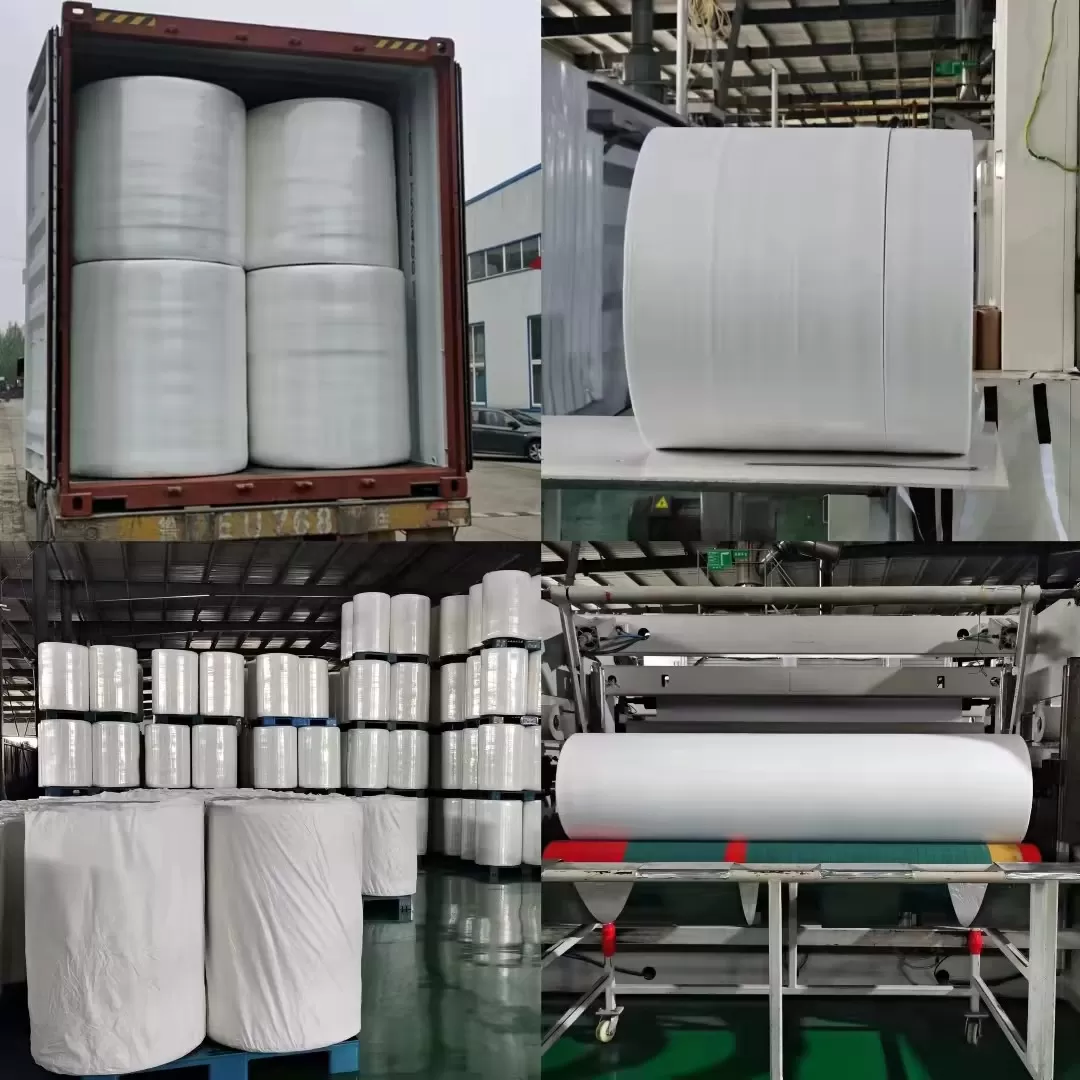
In high-speed production environments, the raw breathable PE backsheet film is rarely used in isolation. To provide a textile finish, the film is laminated to a light nonwoven material, typically a 10 to 15 gsm spunbond polypropylene (PP) or polyethylene/polypropylene (PE/PP) bicomponent web, producing a cloth-like textile backsheet (TBS).
Lamination Technologies: Hot-Melt Adhesive vs. Ultrasonic Bonding
Joining these layers on high-speed webs requires consistent processing conditions. Using hot-melt adhesive lamination, formulated from synthetic elastomers (such as SBS or SEBS), converters use slot-die, spray, or multi-bead application patterns. Glue temperatures must be tightly controlled; high thermal energy can melt the thin PE membrane, creating pinholes that ruin liquid retention. Adhesive add-on weights typically range between 1.0 and 2.5 gsm.
Ultrasonic bonding eliminates the need for hot-melt adhesives by using high-frequency mechanical vibration to melt contact points. This method avoids the MVTR loss that happens when adhesive blankets the micro-voids. However, running ultrasonic units at speeds above 600 meters per minute demands specialized web tracking and anvil-to-horn distance control. Equipment engineered by manufacturers such as KIMEPR is integrated into converting streams to manage web tension and ensure uniform bonding, helping to prevent web wander or delamination during high-speed production.
Web Control, Static Mitigation, and Slitting Dynamics
The inclusion of large amounts of mineral filler alters the surface energy and electrical conductivity of the film. Breathable films accumulate static charges during unwinding, attracting ambient dust and causing sheet clinging that interrupts downstream cutting and folding.
Rotary slitting setups must use razor-sharp, precisely matched carbide blades. A blunt knife edge can cause cross-direction micro-tears along web borders. Given the directional orientation introduced in the MDO unit, edge defects can trigger complete web breaks across the converting line, leading to unplanned downtime.
Application Verticals: Hygiene, Healthcare, and Protective Barriers
The integration of breathable PE backsheet film spans multiple end-use markets, each with distinct performance thresholds and regulatory demands.
Baby Diaper Systems
Baby diapers represent the largest commercial volume for breathable barriers. In this segment, the film prevents liquid leakage while allowing water vapor to dissipate, helping to prevent diaper rash. The film surface must also accept high-definition flexographic printing with water- or solvent-based inks, requiring sustained corona treatment levels (typically 38 to 44 dynes/cm) without pinhole formation.
Adult Incontinence Garments
Adult incontinence products require backsheets that withstand higher hydraulic pressures from large volume voids while maintaining vapor breathability. Because these users are often seated or bedridden for extended periods, hydrostatic head values must exceed the weight pressures exerted by the human body to prevent wet-through, all while operating under strict total-quietness requirements to preserve user dignity.
Medical Protective Apparel
In medical fields, breathable backsheets serve as components in surgical drapes, isolation gowns, and protective garments. These applications require viral and bacterial barrier performance alongside breathability to prevent worker heat stress. Films in this category must meet biological barrier specifications, such as ASTM F1670 and F1671, while retaining their mechanical barrier properties after ethylene oxide (EtO) or gamma radiation sterilization.
Quality Assurance Protocols and Standardized Testing
Verifying performance consistency across extruded master rolls requires standardized mechanical and analytical quality-control regimens.
Moisture Vapor Transmission Testing Methodologies
MVTR measurements determine the mass of water vapor passing through a specified surface area over a 24-hour cycle. Standardized test methods include:
ASTM E96 (Gravimetric Method): Uses desiccant or water cup systems. It is the absolute reference standard, though test cycles range from 8 to 24 hours.
Electrolytic Detection / Infrared Sensing: Modern laboratory units, such as Lyssy instruments, deliver calibrated results within minutes by measuring relative humidity changes in an isolated chamber. This rapid testing allows for timely adjustments to MDO line draw conditions.
Hydrostatic Head (Hydrohead) Determination
Evaluated under AATCC 127 or ISO 811, this test assesses the liquid barrier capacity of the film. Water pressure is applied to a 100 cm² specimen surface at a steady ramp rate (typically 10 or 60 mbar/min) until three droplet leaks break through the membrane. Well-cavitated films must hold their barrier integrity beyond specified thresholds without stretching or pinhole development.
Pinhole and Visual Inspection Systems
Modern extrusion and converting setups rely on automated line-scan cameras and electrostatic discharge detectors. Microscopic pinholes, caused by un-dispersed mineral agglomerates, contaminated gel particles, or thermal ruptures, are flagged in real time. Defect coordinates are logged to allow for automated rejection during final diaper assembly.
Technical Iterations: Formulation Advancements and Sustainability
Hygiene market regulations and consumer demand continue to push manufacturers toward sustainable, low-carbon footprints. These expectations require raw material and machine builders to refine polymer configurations and processing systems.
One primary focus is reducing the dependence on fossil-based PE resins. Replacing conventional feedstocks with bio-based LLDPE derived from sugarcane ethanol produces a chemically identical drop-in polymer that maintains established cavitation and converting characteristics without demanding machine reconfigurations.
The industry is also working to incorporate post-consumer recycled (PCR) and post-industrial recycled (PIR) polyolefins. While blending high fractions of recycled polyolefins into ultra-thin microporous matrices presents technical challenges—such as variable melt indexes and trace particulates that introduce pinholes—controlled processing enables functional structures. Production platforms developed by KIMEPR continue to incorporate adaptive tension loops and advanced extrusion geometries, making it possible to run these sustainable polymer blends without compromising line output speeds or structural reliability.
Frequently Asked Questions
What is the primary operational difference between breathable film and microporous film?
In the hygiene manufacturing sector, the terms are often used interchangeably. Breathable film refers to the functional performance—the transmission of water vapor while blocking liquids—whereas microporous film describes the structural mechanism. A microporous film achieves this breathability via billions of sub-micron voids produced through mineral debonding, distinct from monolithic films that transport moisture via molecular absorption and solid-state diffusion.
Why does calcium carbonate aggregate size matter during extrusion?
If the calcium carbonate contains coarse particles larger than 3 to 5 microns, or if the surface stearic-acid coating is uneven, the filler will agglomerate in the melt. During the downstream MDO stretching process, these clusters create localized high-stress concentrations, resulting in pinholes and film tears rather than uniform micro-voids. This issue degrades hydrohead barrier performance and causes web breaks.
How does down-gauging breathable PE backsheet film affect hot-melt lamination?
As the film thickness drops below 14 gsm, the total thermal mass decreases. When hot-melt adhesive hits the thin film, residual heat can melt through the polyolefin web, causing burn-through defects and structural failures. Converters must use adhesives with lower application temperatures, switch to fine-fiber spray nozzles, or transition to ultrasonic bonding processes.
Can breathable PE backsheet film be printed on inline?
Yes. Films can be printed using inline or offline flexographic and rotogravure presses. The non-polar surface of polyethylene requires corona discharge treatment to elevate surface energy to between 38 and 44 dynes/cm, ensuring proper ink adhesion. Printers must use inks with solvent balances that dry rapidly without swelling the thin PE web or causing solvent-induced stress cracking.
What causes breathability loss after laminating the film to a nonwoven web?
Loss of MVTR after lamination typically stems from adhesive over-application. Using a continuous slot-die adhesive coating seals off the micro-voids on the film surface, preventing vapor from entering the pathways. Using spiral-spray, melt-blown, or patterned application methods keeps the majority of the microporous surface open, preserving breathability.
Engineering Partnership and Technical Consultation
Optimizing web stability, breathability, and mechanical performance at high machine speeds requires close collaboration between material science and converting equipment design. For specialized line integration, technical assessments of engineered converting platforms, and tooling configurations tailored to your film specifications, contact the engineering team attina@kimbersolution.com / scarlet@kimbersolution.com.